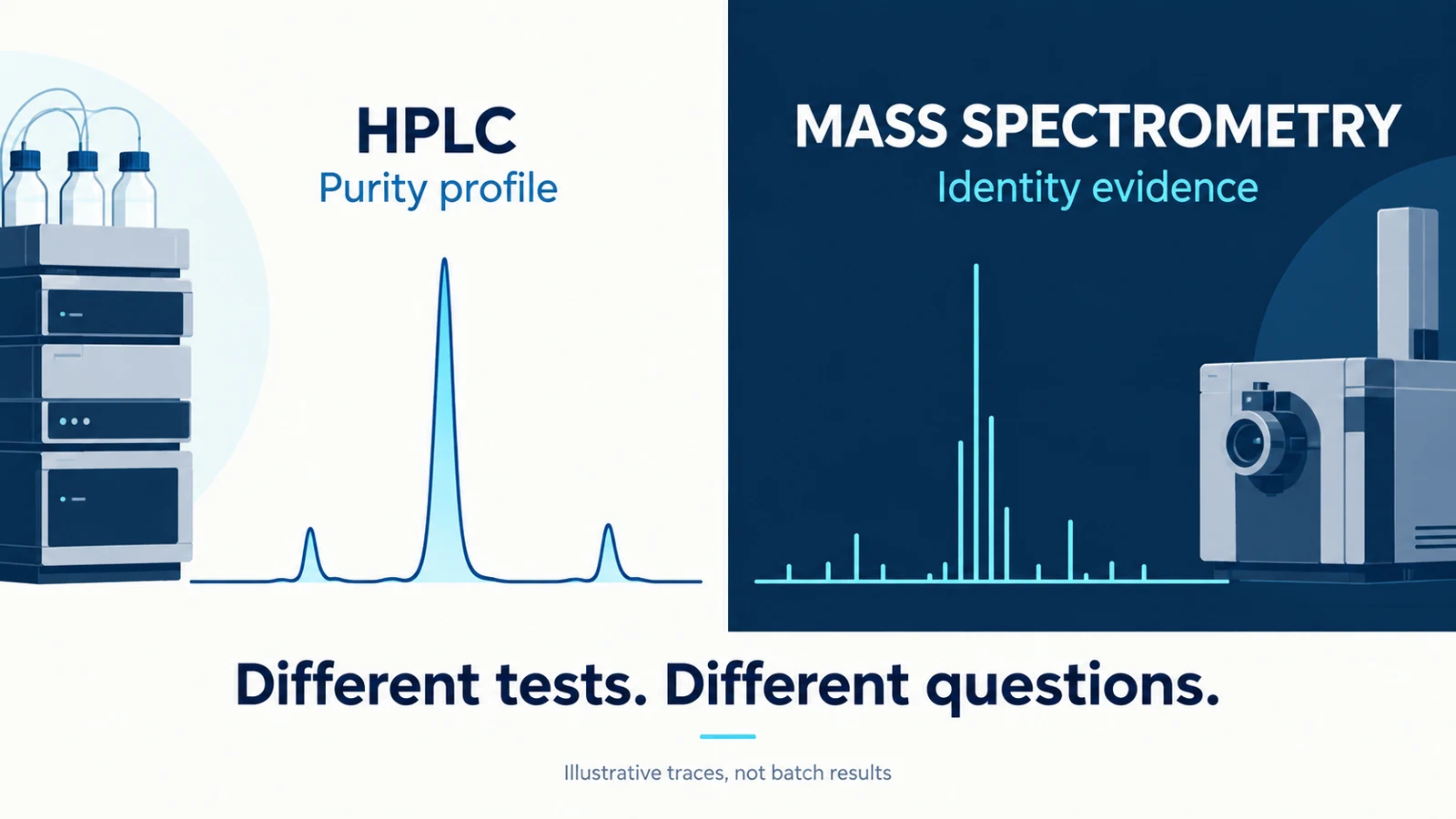
A peptide Certificate of Analysis can contain several measurements that answer different questions. HPLC purity, mass-spectrometry identity and peptide content are not interchangeable. Reading them separately helps a laboratory decide whether a report supports the material it plans to procure.
For laboratory research only. Not for human or animal use. This guide provides no dosing, administration or therapeutic advice.
The short answer
HPLC separates sample components under a defined analytical method. A reported purity percentage describes the measurement made using that method and detector. Mass spectrometry supplies mass-related evidence that can support a compound assignment. Neither a high purity percentage nor a matching mass alone answers every question about a vial.
What HPLC purity actually describes
Bachem’s analytical FAQ explains that its HPLC purity measurement with UV detection compares the requested peptide with the material absorbing at the stated wavelength. That includes the desired product, peptidic by-products and other detected impurities. The conditions matter: read the method and detector information rather than treating the percentage as a universal description of everything in the sample.
A chromatogram is the plotted detector response over the separation. Review which peak was assigned to the requested material, how the report describes additional peaks and whether the document explains its calculation. A large main peak can be useful evidence, but a picture without the method or a clear sample identifier leaves questions open.
Waters notes that conventional liquid chromatography with optical detection has limitations when impurities are unresolved or the analyst needs to identify a new peak. Its peptide-analysis example combines chromatography with high-resolution mass spectrometry to obtain more information. That is a reason to read methods together, not a reason to declare every HPLC-only report invalid.
What mass spectrometry adds
Mass spectrometry measures mass-to-charge information. In the Waters example, accurate mass supports peptide assignments, while fragmentation data adds evidence about sequence and impurities. The report should state what was actually measured. A reference to “MS” is not a promise that sequence confirmation, impurity identification and quantitative analysis were all performed.
Look for the expected identity, the observed result, the analytical method and the laboratory’s interpretation. If those details are absent, ask for clarification instead of supplying your own conclusion from a single number.
Purity is not the same as peptide content
Bachem distinguishes HPLC purity from peptide content and assay. Its FAQ explains that lyophilized peptide material can contain water and counterions. A percentage describing the detected peptide-related components does not by itself state the mass of peptide present in a vial.
For procurement, keep three fields separate: the amount on the catalog label, the purity result under the stated method and any measured content or quantity result. Do not calculate a vial’s verified peptide amount from a purity percentage unless the report and calculation basis support that use.
A practical COA review checklist
- Match the compound name, strength, format and sample or batch identifier to the offered item.
- Read the test date, laboratory name and report reference.
- Identify which results concern purity, identity and measured content.
- Check whether the method and units are stated for each result.
- Follow the laboratory’s verification route when one is supplied.
- Ask about missing or conflicting information before treating it as confirmed.
Start with the Shop Peptides Online COA library and compare it with the exact listing in the research peptide catalog. A report for a related product or an earlier batch is not automatically evidence for the item currently offered.
Read a report in three passes
Trying to decide everything from the largest number on the page is an easy way to miss an important mismatch. A more useful approach is to separate traceability, analytical evidence and procurement decisions. Each pass has a different purpose.
Pass 1: establish which sample the document describes
Start with the report header, not the purity result. Record the sample description, the laboratory reference and the test date. Then compare those fields with the offered item and its batch information. For example, the BPC-157 research hub contains separate vial listings as well as blends. Compare the BPC-157 5MG vial listing with the exact document you are reading. A report for a BPC-157 sample is not automatically a report for a BPC-157/TB-500 mixture, even when the products share part of their names.
This first pass does not judge whether a result is good or bad. It establishes whether you are reading evidence for the right material. If the batch number is absent from the copy, mark the match as unresolved. Do not replace a missing identifier with an assumption based on a similar label or a familiar supplier.
Pass 2: identify the question each test answers
Make a small record with a separate row for purity, identity and measured quantity. Copy the result, units and stated method into the relevant row. If the document reports HPLC purity but no measured amount, leave the amount field empty. That is more accurate than calculating a new “verified” value from the vial label.
Read the laboratory’s interpretation alongside the numbers. A result can be meaningful without answering every possible question. Conversely, a familiar method abbreviation cannot substitute for a result that the laboratory did not report. Our component-by-component blend COA guide applies the same separation to mixtures.
Pass 3: record the remaining procurement questions
The final pass asks what still needs clarification before a laboratory chooses a material. That may be a batch match, a missing unit, a component assignment or a format difference. Keep those questions separate from handling and shipping questions. Our research procurement guide covers that wider review.
A worked example: what a result does and does not establish
Consider a hypothetical report that lists a sample identifier, an HPLC purity result and an observed mass. The numbers below are deliberately omitted because this is a reading exercise, not a claim about any Shop Peptides Online batch.
- Sample identifier: supports linking the document to a named submitted sample. It still needs to be matched to the offered material.
- HPLC purity: describes the result under the stated separation and detection conditions. It does not automatically quantify all water, salts or material invisible to that detector.
- Observed mass: supplies mass-related evidence. Review the laboratory’s assignment and whether additional fragmentation or sequence work is described.
- No quantity result: leaves measured amount unresolved. The label amount remains a listing field, not a new analytical result.
The correct summary would say which measurements are present and which are absent. It would not turn the report into a safety guarantee, a certificate of suitability for human use or a promise that every vial in a later shipment is identical.
When reports cannot be compared directly
Two purity percentages can look comparable while being produced under different analytical conditions. Bachem’s FAQ notes that peptide analytical data can include purity values obtained in different buffer systems. Before treating a difference as a meaningful quality ranking, check whether the laboratories describe comparable methods and calculation bases.
Ask whether the detector, separation conditions and sample preparation are described. Check whether the main peak assignment is explained and whether both reports concern the same compound and format. If you cannot establish that comparison, preserve the uncertainty. A higher printed percentage is not a substitute for a better-documented sample match.
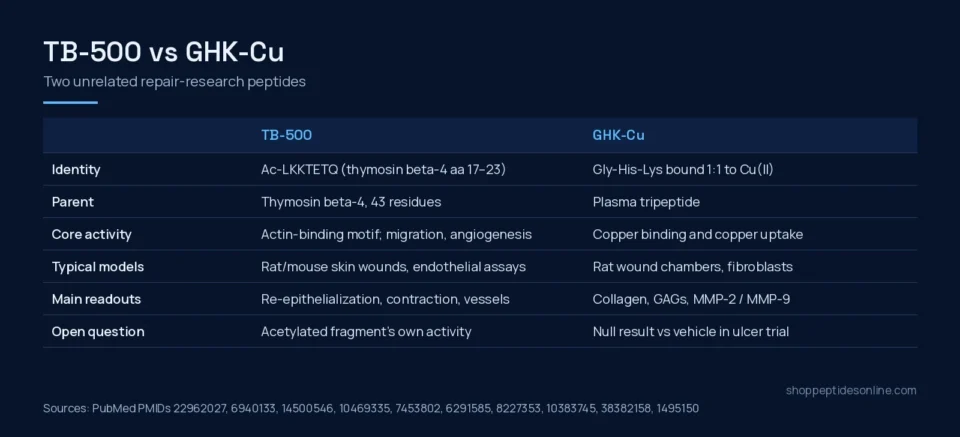
The TB-500 catalog hub and GHK-Cu catalog hub provide examples of separate compound destinations. Their product names and formats should stay separate in your records, even if their reports use similar-looking layouts.
What to save in a laboratory procurement record
Keep a copy of the original report, its reference, the product listing you reviewed and the date of your comparison. Record the batch identifier when available. Keep the laboratory’s actual wording for conclusions you rely on, rather than rewriting a limited observation as a broad guarantee.
A useful note might read: “Identity and purity results reviewed; sample-to-current-batch match awaiting confirmation.” That is more honest and more useful to the next reader than “fully verified” when part of the chain is still missing. For a broader comparison record, use the research material and batch comparison guide.
Keep analytical records apart from laboratory supply listings. A diluent, needle or alcohol pad listing is not identity or purity evidence for the peptide material beside it.
Questions to send when something is missing
- Which current batch or sample identifier does this report correspond to?
- What method and detector produced the stated purity result?
- Does the report include identity evidence, and how did the laboratory interpret it?
- Was peptide content or quantity measured separately? If so, what is the basis and unit?
- Can the original report be checked through the issuing laboratory?
These are documentation questions, not a request for administration instructions. Use the store contact page for listing or batch clarification and the issuing laboratory’s own route for questions about analytical interpretation. Continue through the Peptide Basics articles for related research-documentation reading.
Common questions
Does 99% HPLC purity mean the vial contains 99% peptide by weight?
Not automatically. Read the detector, method and calculation basis. HPLC purity and peptide content are different measurements.
Does a matching mass prove every feature of a peptide?
No single result should be stretched beyond the test described. Review the laboratory’s identity interpretation and any additional sequence or impurity work it actually performed.
Does a COA establish suitability for human use?
No. These catalog materials are supplied for laboratory research. An analytical result is not medical approval or administration guidance.