For laboratory research only. Not for human or animal use. This article gives no dosing, administration or therapeutic advice.
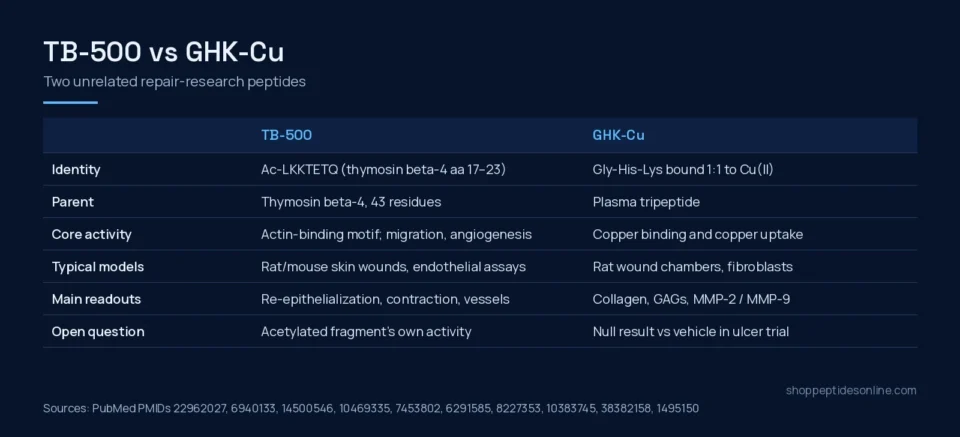
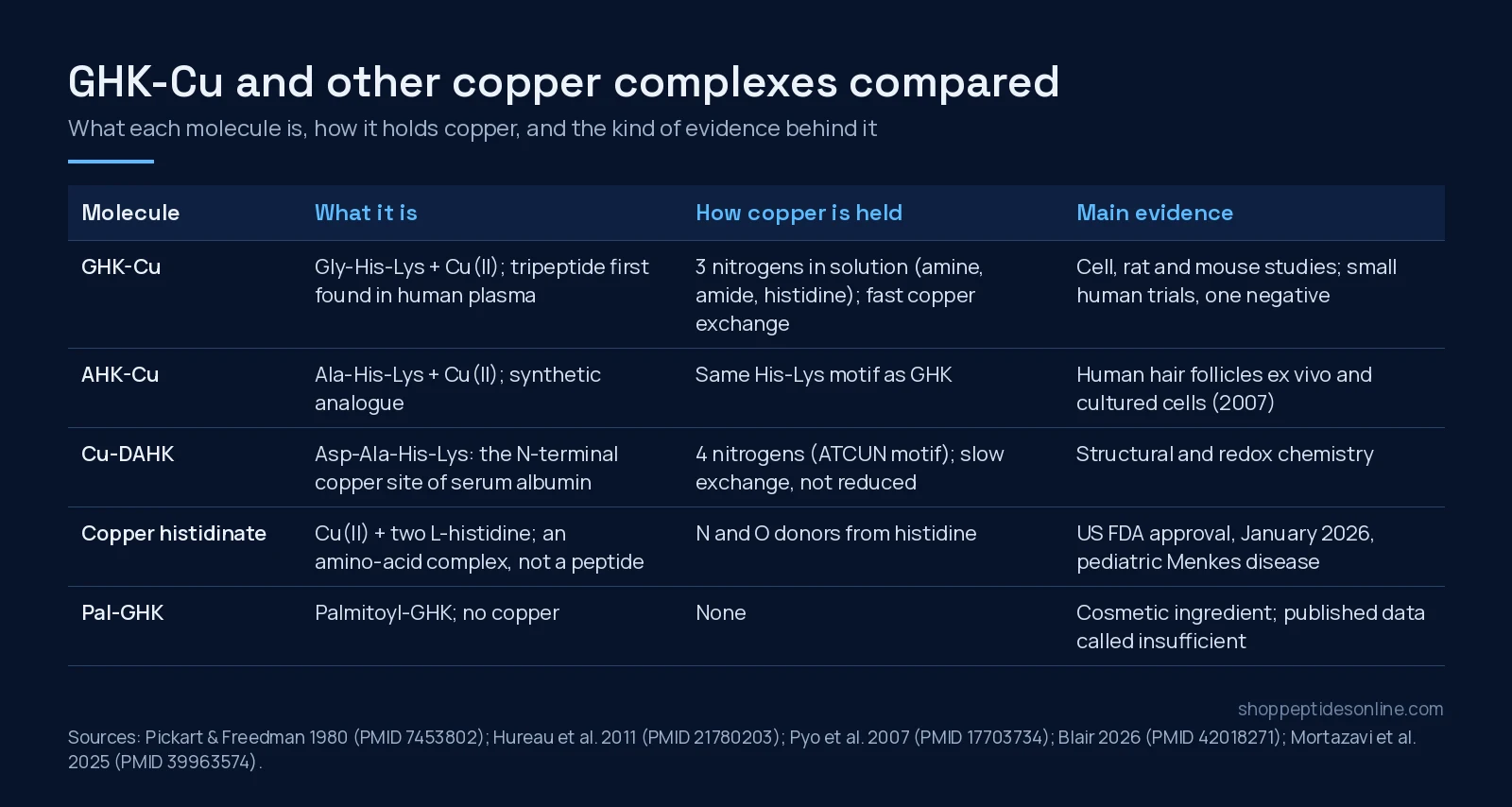
Short answer: “copper peptide” is a category, and GHK-Cu is only its best-studied member. GHK-Cu is glycyl-histidyl-lysine bound to one copper(II) ion, a tripeptide first isolated from human plasma.[1],[2] Its closest relative, AHK-Cu, swaps glycine for alanine and has a much smaller literature.[3] Albumin’s own copper site, DAHK, holds copper more tightly and exchanges it far more slowly than GHK does.[4] And the only copper complex to reach drug approval, copper histidinate, is not a peptide at all.[5] Grouping them under one name hides differences in chemistry and in the quality of the evidence.
Where GHK came from
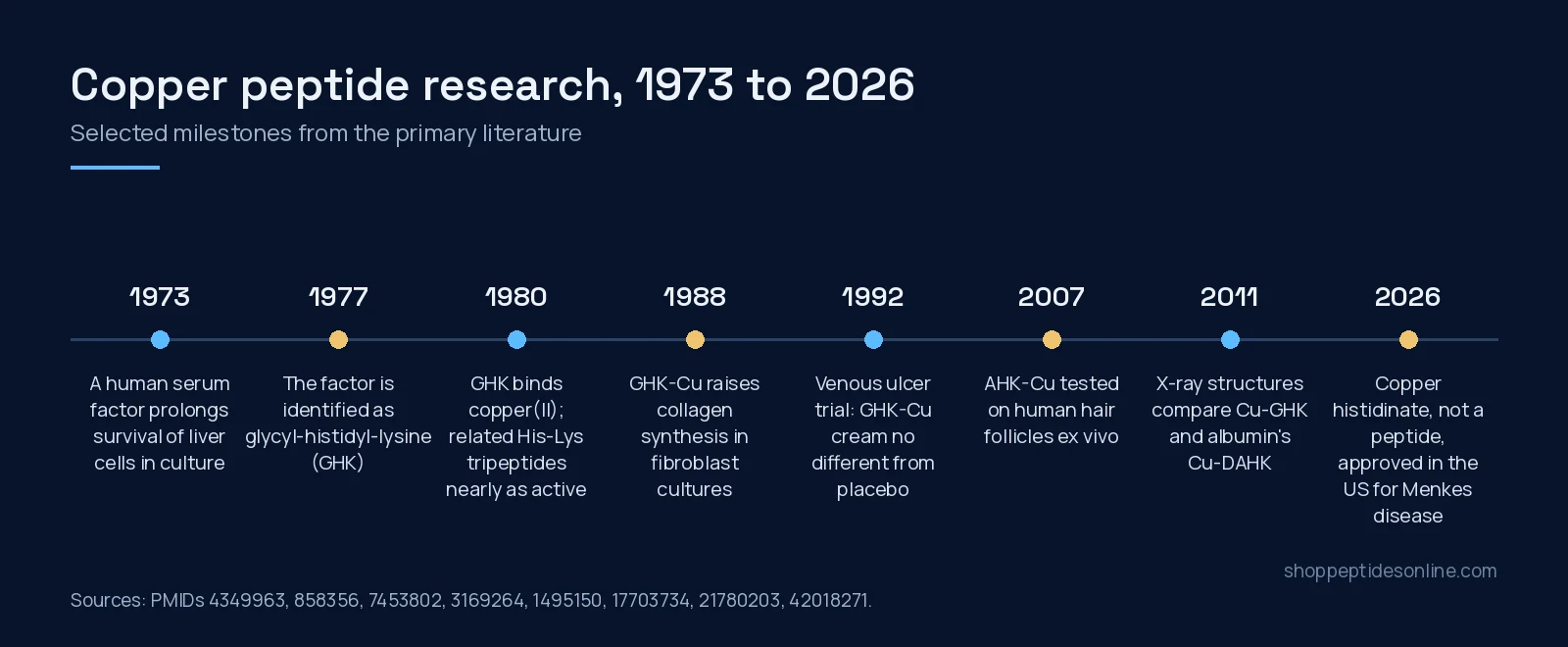
In 1973, Pickart and Thaler reported a factor in human serum that prolonged the survival of normal liver cells in culture and stimulated growth in liver tumour cells.[6] Four years later it was identified as the tripeptide glycyl-histidyl-lysine.[1] In 1980 Pickart and Freedman showed that GHK co-isolated with roughly equimolar copper, readily formed copper(II) complexes, and increased copper uptake into cultured hepatoma cells. They also noted that several other tripeptides with a histidyl-lysyl link were nearly as active.[2] That observation is the origin of the “other copper peptides” question: from the start, the His-Lys motif mattered more than the glycine.
The molecules people compare with GHK-Cu
| GHK-Cu | AHK-Cu | Cu-DAHK | Copper histidinate | |
|---|---|---|---|---|
| Ligand | Gly-His-Lys (tripeptide) | Ala-His-Lys (tripeptide) | Asp-Ala-His-Lys (tetrapeptide) | Two L-histidine amino acids |
| Origin | Found in human plasma[6],[1] | Synthetic analogue[3] | N-terminus of human serum albumin[4] | Synthetic[7] |
| Copper binding | Monomeric in solution, three nitrogen donors, one labile site[8],[4] | His-Lys motif shared with GHK[3] | Four nitrogen donors (ATCUN motif)[4],[9] | Nitrogen and oxygen donors from histidine[7] |
| Copper exchange and redox | Fast exchange; reducible to Cu(I) with copper release[4] | Not characterised in the papers we found | Very slow exchange; not reduced in the same test[4] | Not compared in these papers |
| Human data | Small trials; a 1992 venous ulcer trial found no difference from placebo[10] | None published that we found | Model chemistry only | US FDA approval in January 2026 for pediatric Menkes disease[5],[7] |
AHK-Cu (L-alanyl-L-histidyl-L-lysine-Cu2+) is the analogue most often sold next to GHK-Cu. The main primary paper is a 2007 study on human hair follicles kept alive outside the body and on cultured dermal papilla cells. AHK-Cu lengthened the follicles and increased cell proliferation; it also shifted apoptosis markers, although the drop in the count of apoptotic cells did not reach significance.[3] That is ex vivo and cell-culture evidence, and we found no published human trial of AHK-Cu.
Cu-DAHK is a useful reference point because the body already makes it: Asp-Ala-His-Lys is the N-terminal copper-binding site of human serum albumin. A 2011 structural study solved both complexes. Copper in DAHK sits in a four-nitrogen pocket and exchanges between peptides very slowly. Copper in GHK is held by three nitrogens with a fourth site open, exchanges quickly, and can be reduced to Cu(I) with release of the copper ion, which DAHK did not show.[4] The authors of a 2021 review describe such amino-terminal (ATCUN) sites as candidate copper-transport agents and stress that binding kinetics, not just affinity, decide how copper moves.[9]
Copper histidinate is copper(II) coordinated by two histidine molecules, with a molecular weight of 371.84.[7] In January 2026 it received its first approval from the US Food and Drug Administration, for Menkes disease in pediatric patients, a genetic disorder of copper transport.[5] It sometimes appears in copper peptide discussions, but it is an amino-acid complex developed as a copper-replacement drug. Its approval says nothing about GHK-Cu.
Palmitoyl-GHK carries no copper. It is a fatty-acid-modified GHK used in cosmetics, and a 2025 review found the published data on its skin permeability and effectiveness, and on GHK-Cu’s, to be insufficient.[11]
What the GHK-Cu evidence looks like, by model
Most GHK-Cu data come from cells and rodents. The human record is thin, and the one randomised trial we could find with a clear comparison was negative.
| Study | Model | Finding | Limit |
|---|---|---|---|
| Maquart 1988[12] | Fibroblast cultures | GHK-Cu raised collagen synthesis without changing cell number | Cell culture only |
| Maquart 1993[13] | Rat wound-chamber implants | More connective tissue accumulation than saline | Implanted chamber, not an open wound |
| Bishop 1992[10] | Human venous stasis ulcers, 86 evaluable patients | Tripeptide-copper cream no different from placebo; silver sulfadiazine reduced ulcer size | Negative result for GHK-Cu |
| Pyo 2007[3] | Human hair follicles ex vivo; dermal papilla cells | AHK-Cu lengthened follicles and increased cell proliferation; the drop in apoptotic cells was not significant | Explant and cell data only |
| Fu 2015[14] | Rat ACL reconstruction | Less knee laxity at 6 weeks; no difference at 12 weeks, and no difference in ultimate load, gait or histology | Effect faded once treatment stopped |
A systematic evidence map published in August 2026 reached a similar view. It found preclinical data consistent on matrix remodelling, epithelial repair, inflammation and angiogenesis, but clinical evidence that is sparse and does not meet current standards for defining the active substance. It also pointed out that many studies do not report how much of the copper is actually bound to GHK, as opposed to free copper or copper-free peptide.[15]
Why the copper number on a COA matters
That last point is practical. A GHK-Cu sample is two things: peptide and metal. A useful certificate reports both. The Janoshik report posted for SPO’s GHK-Cu 100mg listing (#218248, analysed 19 August 2026) gives 76.04 mg of GHK-Cu per vial, split into 63.73 mg of GHK peptide and 12.31 mg of copper, at 99.661% purity. Our own arithmetic on those figures: 63.73 mg of GHK (340.38 g/mol) is about 0.187 mmol, and 12.31 mg of copper (63.55 g/mol) is about 0.194 mmol, a ratio close to one copper per peptide, which is what the 1:1 complex predicts.[8] The 50mg listing has no posted report yet. The full record for each is in the COA library.
The GHK-Cu research hub covers the compound’s identity and study table in more depth. The listings are GHK-Cu 50mg and GHK-Cu 100mg. For shipping and ordering within Canada, see how to buy peptides online in Canada.
Frequently asked questions
Is GHK-Cu the same as “copper peptides”?
No. GHK-Cu (glycyl-histidyl-lysine with one copper ion) is the best-studied copper peptide, but the term also covers analogues such as AHK-Cu and natural copper sites such as albumin’s DAHK. Their copper binding and evidence base differ, so results for one should not be assumed for another.
How is AHK-Cu different from GHK-Cu?
AHK-Cu replaces the first amino acid, glycine, with alanine and keeps the His-Lys copper-binding motif. Its primary literature is much smaller: the main paper is a 2007 study on human hair follicles ex vivo and cultured dermal papilla cells. We found no published human trial.
Is any copper peptide an approved drug?
We found no approved GHK-Cu or AHK-Cu medicine. The copper complex approved by the US FDA in January 2026, copper histidinate for pediatric Menkes disease, is made of two histidine amino acids and copper, not a peptide.
What should a GHK-Cu certificate of analysis show?
Ideally the GHK peptide and the copper separately, as well as the total and the purity. The two figures let you check that the copper-to-peptide ratio is close to the 1:1 complex, a detail a 2026 evidence review says many studies leave out.
References
- Schlesinger DH, Pickart L, Thaler MM (1977). Growth-modulating serum tripeptide is glycyl-histidyl-lysine. Experientia. PMID: 858356. doi: 10.1007/BF02002806.
- Pickart L, Freedman JH, Loker WJ et al. (1980). Growth-modulating plasma tripeptide may function by facilitating copper uptake into cells. Nature. PMID: 7453802. doi: 10.1038/288715a0.
- Pyo HK, Yoo HG, Won CH et al. (2007). The effect of tripeptide-copper complex on human hair growth in vitro. Arch Pharm Res. PMID: 17703734. doi: 10.1007/BF02978833.
- Hureau C, Eury H, Guillot R et al. (2011). X-ray and solution structures of Cu(II) GHK and Cu(II) DAHK complexes: influence on their redox properties. Chemistry. PMID: 21780203. doi: 10.1002/chem.201100751.
- Blair HA (2026). Copper Histidinate: Pediatric First Approval. Paediatr Drugs. PMID: 42018271. doi: 10.1007/s40272-026-00750-9.
- Pickart L, Thaler MM (1973). Tripeptide in human serum which prolongs survival of normal liver cells and stimulates growth in neoplastic liver. Nat New Biol. PMID: 4349963.
- Aktaruzzaman M, Wang Z, Yu Y et al. (2026). Zycubo (copper histidinate), the first treatment for pediatric Menkes disease. Trends Pharmacol Sci. PMID: 41820156. doi: 10.1016/j.tips.2026.02.005.
- Freedman JH, Pickart L, Weinstein B et al. (1982). Structure of the Glycyl-L-histidyl-L-lysine–copper(II) complex in solution. Biochemistry. PMID: 6291585. doi: 10.1021/bi00262a004.
- Kotuniak R, Bal W (2021). Kinetics of Cu(II) complexation by ATCUN/NTS and related peptides: a gold mine of novel ideas for copper biology. Dalton Trans. PMID: 34816848. doi: 10.1039/d1dt02878b.
- Bishop JB, Phillips LG, Mustoe TA et al. (1992). A prospective randomized evaluator-blinded trial of two potential wound healing agents for the treatment of venous stasis ulcers. J Vasc Surg. PMID: 1495150. doi: 10.1067/mva.1992.37086.
- Mortazavi SM, Mohammadi Vadoud SA, Moghimi HR (2025). Topically applied GHK as an anti-wrinkle peptide: Advantages, problems and prospective. Bioimpacts. PMID: 39963574. doi: 10.34172/bi.30071.
- Maquart FX, Pickart L, Laurent M et al. (1988). Stimulation of collagen synthesis in fibroblast cultures by the tripeptide-copper complex glycyl-L-histidyl-L-lysine-Cu2+. FEBS Lett. PMID: 3169264. doi: 10.1016/0014-5793(88)80509-x.
- Maquart FX, Bellon G, Chaqour B et al. (1993). In vivo stimulation of connective tissue accumulation by the tripeptide-copper complex glycyl-L-histidyl-L-lysine-Cu2+ in rat experimental wounds. J Clin Invest. PMID: 8227353. doi: 10.1172/JCI116842.
- Fu SC, Cheuk YC, Chiu WY et al. (2015). Tripeptide-copper complex GHK-Cu (II) transiently improved healing outcome in a rat model of ACL reconstruction. J Orthop Res. PMID: 25731775. doi: 10.1002/jor.22831.
- Mateescu DM, Gavrilescu DM, Mincioaga RI et al. (2026). GHK-Cu as a Bioactive Metallopeptide and Drug-Delivery Cargo: Coordination Chemistry, Formulation Science, Therapeutic Evidence, and a Translational Roadmap. Pharmaceutics. PMID: 42797253. doi: 10.3390/pharmaceutics18091077.