For laboratory research only. Not for human or animal use. This article gives no dosing, administration or therapeutic advice.
Short answer: BPC-157 and GHK-Cu are often grouped together as “repair peptides”, but they have almost nothing in common chemically. BPC-157 is a 15-residue fragment of a larger protein first described in gastric juice[1][2]. GHK-Cu is a three-residue peptide, glycyl-histidyl-lysine, found in human serum, which carries a copper(II) ion[3][4][5]. Their mechanism papers point in different directions: BPC-157 toward VEGFR2, nitric-oxide signalling and tendon fibroblast migration[6][7][8]; GHK-Cu toward copper delivery and collagen and matrix synthesis[5][9][10]. Our PubMed search (October 2026) found no study that tests the two against each other.
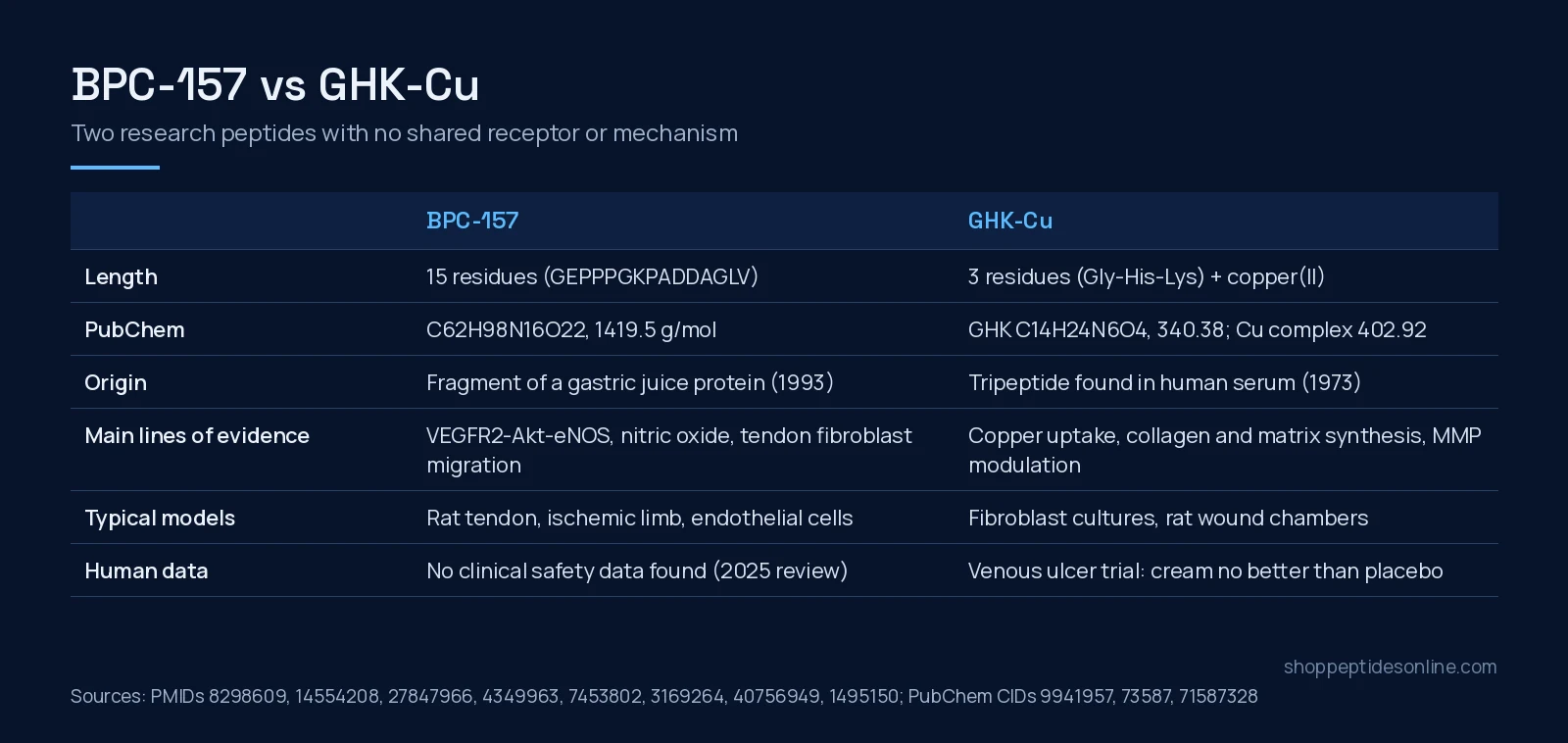
Side by side
| BPC-157 | GHK-Cu | |
|---|---|---|
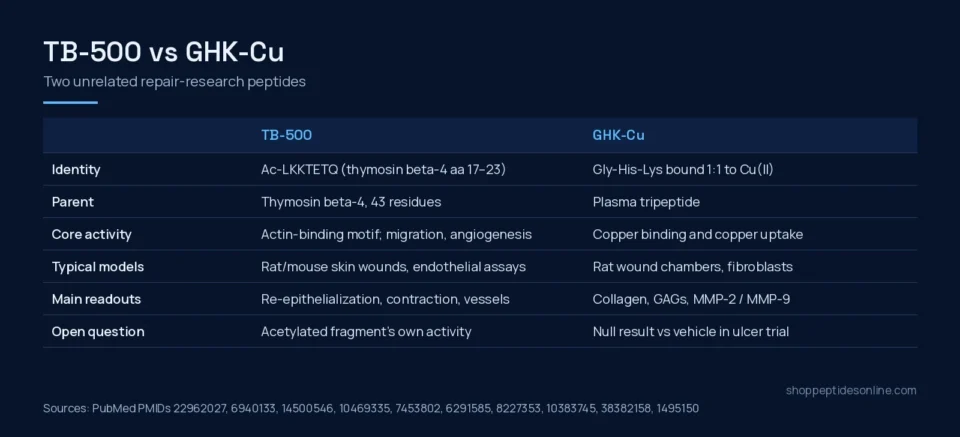
| Sequence | GEPPPGKPADDAGLV, 15 residues[2][11] | Gly-His-Lys, 3 residues, bound 1:1 to Cu(II)[4][12] |
| Formula (PubChem) | C62H98N16O22, 1419.5 g/mol (CID 9941957) | GHK: C14H24N6O4, 340.38 g/mol (CID 73587); copper complex: 402.92 g/mol (CID 71587328) |
| First described | 1993, as a fragment of a gastric juice protein named BPC[1] | 1973, as a serum tripeptide affecting liver cells; identified as Gly-His-Lys in 1977[3][4] |
| Main lines of evidence | VEGFR2-Akt-eNOS signalling, nitric-oxide system, tendon fibroblast outgrowth and migration[6][7][8] | Copper uptake, collagen synthesis, matrix metalloproteinase changes in wounds[5][9][13] |
| Typical models | Rat tendon transection, rat ischemic hind limb, cultured endothelial cells[2][6] | Fibroblast cultures, rat subcutaneous wound chambers[9][10] |
| Human data | A 2025 systematic review found no clinical safety data[14] | In a randomised venous-ulcer trial, a tripeptide-copper cream did no better than placebo[15] |
| At SPO | BPC-157 10mg | GHK-Cu 50mg |
Two very different origins
BPC-157. In 1993, Sikirić and colleagues described a gastric juice protein of about 40 kDa, which they named BPC, and characterised a 15-amino-acid fragment, BPC 157, that they considered essential for its activity[1]. Later papers from the same research tradition describe it as stable in human gastric juice[7]. It entered clinical trials for inflammatory bowel disease under the codes PL 14736 and PLD-116[2][11].
GHK-Cu. The story starts in 1973 with a tripeptide in human serum that prolonged the survival of normal liver cells and stimulated growth in neoplastic liver tissue[3]. By 1977 it had been identified as glycyl-histidyl-lysine[4]. During its isolation the peptide kept co-purifying with roughly equimolar copper, it readily formed copper(II) complexes, and it increased copper uptake into cultured hepatoma cells; its effects on those cells were greatest when copper was present[5]. Spectroscopy later showed a 1:1 complex at neutral pH, with one of the copper-binding nitrogens in the histidine imidazole ring[12].
What the mechanism papers show
BPC-157
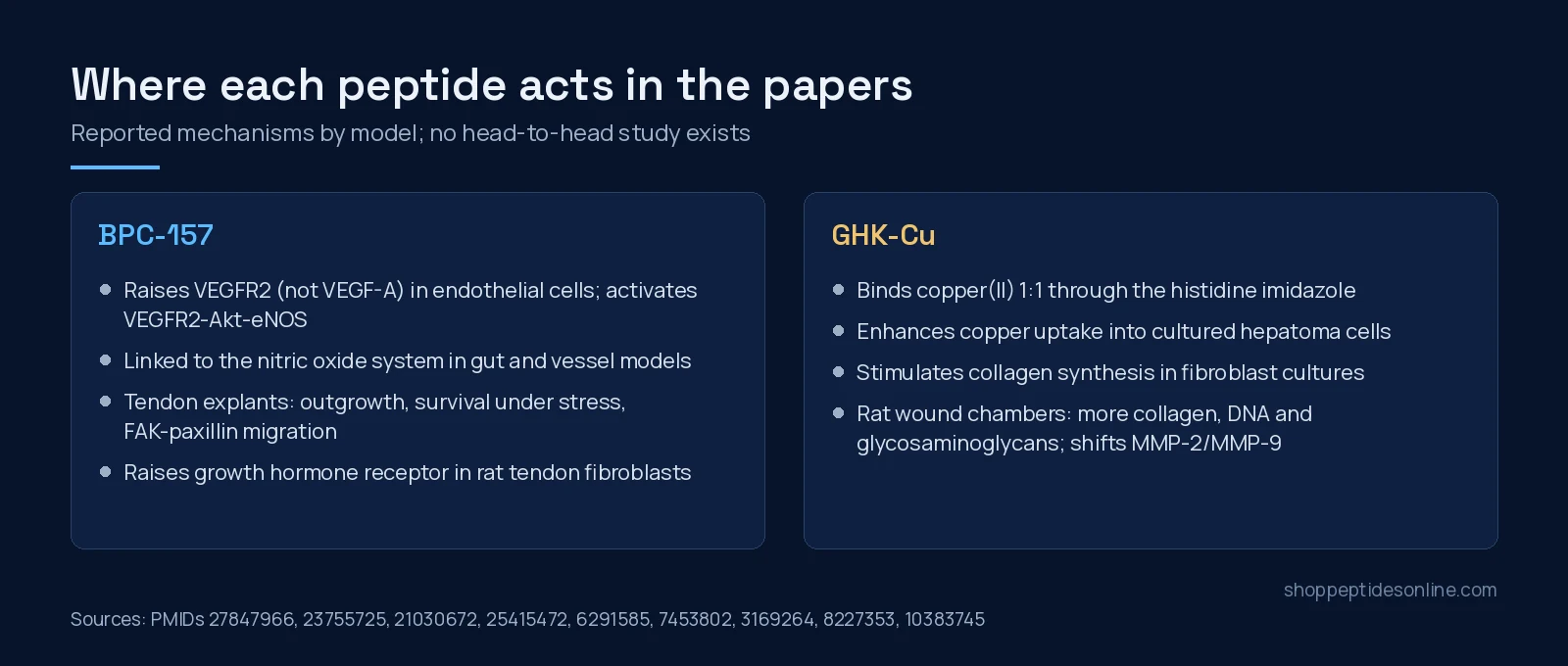
- Blood vessels. In a chick membrane assay and an endothelial tube-formation assay, BPC-157 increased vessel density. In rats with an ischemic hind limb it sped the recovery of blood flow. In human endothelial cells it raised VEGFR2 mRNA and protein, but not VEGF-A, and activated the VEGFR2-Akt-eNOS pathway[6].
- Nitric oxide. A review by the originating group links BPC-157 to the nitric-oxide system across gut and vascular injury models[7].
- Tendon cells. On its own, BPC-157 did not change the growth of cultured tendocytes, but it opposed growth inhibition by 4-hydroxynonenal[2]. In rat tendon explants it promoted fibroblast outgrowth, survival under oxidative stress and migration, apparently through FAK-paxillin signalling[8]. Rat tendon fibroblasts exposed to it expressed more growth hormone receptor[16].
GHK-Cu
- Copper handling. The early work proposed GHK as a copper transport factor, based on its copper binding and its similarity to the copper sites on albumin[5].
- Collagen. In fibroblast cultures, GHK-Cu stimulated collagen synthesis from picomolar concentrations, peaking near 1 nM, without changing cell number. The authors noted that a GHK sequence sits inside the alpha-2 chain of type I collagen[9].
- Wound chambers. In rat subcutaneous wound chambers, GHK-Cu produced a concentration-dependent rise in dry weight, DNA, protein, collagen and glycosaminoglycans, with higher type I and III collagen mRNA[10]. In the same model it did not change collagenase activity but extended MMP-9 expression and raised MMP-2 in later healing stages[13].
- Gene data. A 2018 review links GHK to a wide set of gene-expression pathways. It is a narrative review, not new experimental data[17].
Where the evidence is thin
Both literatures are mostly preclinical, and both include results that should temper the headline claims:
- A 2025 systematic review of BPC-157 in orthopaedic sports medicine covered 36 studies from 1993 to 2024. It rated the evidence as level IV and V, reported a half-life under 30 minutes, found no clinical safety data, and noted that BPC-157 is not FDA-approved and is banned in some sports[14].
- In 86 patients with venous stasis ulcers, silver sulfadiazine reduced ulcer size, but a tripeptide-copper cream was no different from an inert placebo[15].
- In 72 rats after ACL reconstruction, GHK-Cu narrowed knee laxity at 6 weeks but not at 12, and made no difference to ultimate load, gait or histology. The effect faded once treatment stopped[18].
Which one fits which question?
- Angiogenesis and nitric-oxide signalling in injury models: BPC-157 has the more direct mechanistic papers[6][7].
- Tendon fibroblast migration and survival: BPC-157[8][16].
- Copper biology, collagen and matrix remodelling: GHK-Cu[5][9][13].
- Translation: neither has a strong human evidence base, and the randomised GHK-Cu trial above was negative[14][15].
Product details and the full literature summaries are on our BPC-157 research page and GHK-Cu research page. For the rest of the catalogue, see our guide to buy peptides online in Canada.
Frequently asked questions
What is the difference between BPC-157 and GHK-Cu?
BPC-157 is a 15-residue fragment of a gastric juice protein studied mainly in rat injury models. GHK-Cu is a three-residue serum peptide (glycyl-histidyl-lysine) bound to copper(II). They share no receptor or known mechanism.
Has BPC-157 been compared with GHK-Cu in a study?
Not that we could find. A PubMed search in October 2026 returned no study that tests the two peptides head to head; the comparison here sets their separate literatures side by side.
How does GHK-Cu work in lab models?
In the published work, GHK binds copper(II) 1:1, increases copper uptake into cultured cells, stimulates collagen synthesis in fibroblast cultures and changes collagen, glycosaminoglycan and MMP levels in rat wound chambers.
What mechanisms are reported for BPC-157?
Papers report raised VEGFR2 and VEGFR2-Akt-eNOS activation in endothelial cells, links to the nitric-oxide system, and more outgrowth, survival and migration of rat tendon fibroblasts.
Is there human evidence for either peptide?
Very little. A 2025 systematic review found no clinical safety data for BPC-157, and in a randomised venous-ulcer trial a tripeptide-copper cream did no better than placebo. Both are sold by SPO for laboratory research only.
References
- Sikirić P, Petek M, Rucman R et al. (1993). A new gastric juice peptide, BPC. An overview of the stomach-stress-organoprotection hypothesis and beneficial effects of BPC. J Physiol Paris. PMID: 8298609. doi: 10.1016/0928-4257(93)90038-u.
- Staresinic M, Sebecic B, Patrlj L et al. (2003). Gastric pentadecapeptide BPC 157 accelerates healing of transected rat Achilles tendon and in vitro stimulates tendocytes growth. J Orthop Res. PMID: 14554208. doi: 10.1016/S0736-0266(03)00110-4.
- Pickart L, Thaler MM (1973). Tripeptide in human serum which prolongs survival of normal liver cells and stimulates growth in neoplastic liver. Nat New Biol. PMID: 4349963.
- Schlesinger DH, Pickart L, Thaler MM (1977). Growth-modulating serum tripeptide is glycyl-histidyl-lysine. Experientia. PMID: 858356. doi: 10.1007/BF02002806.
- Pickart L, Freedman JH, Loker WJ et al. (1980). Growth-modulating plasma tripeptide may function by facilitating copper uptake into cells. Nature. PMID: 7453802. doi: 10.1038/288715a0.
- Hsieh MJ, Liu HT, Wang CN et al. (2017). Therapeutic potential of pro-angiogenic BPC157 is associated with VEGFR2 activation and up-regulation. J Mol Med (Berl). PMID: 27847966. doi: 10.1007/s00109-016-1488-y.
- Sikiric P, Seiwerth S, Rucman R et al. (2014). Stable gastric pentadecapeptide BPC 157-NO-system relation. Curr Pharm Des. PMID: 23755725. doi: 10.2174/13816128113190990411.
- Chang CH, Tsai WC, Lin MS et al. (2011). The promoting effect of pentadecapeptide BPC 157 on tendon healing involves tendon outgrowth, cell survival, and cell migration. J Appl Physiol (1985). PMID: 21030672. doi: 10.1152/japplphysiol.00945.2010.
- Maquart FX, Pickart L, Laurent M et al. (1988). Stimulation of collagen synthesis in fibroblast cultures by the tripeptide-copper complex glycyl-L-histidyl-L-lysine-Cu2+. FEBS Lett. PMID: 3169264. doi: 10.1016/0014-5793(88)80509-x.
- Maquart FX, Bellon G, Chaqour B et al. (1993). In vivo stimulation of connective tissue accumulation by the tripeptide-copper complex glycyl-L-histidyl-L-lysine-Cu2+ in rat experimental wounds. J Clin Invest. PMID: 8227353. doi: 10.1172/JCI116842.
- Sikiric P, Seiwerth S, Brcic L et al. (2006). Stable gastric pentadecapeptide BPC 157 in trials for inflammatory bowel disease (PL-10, PLD-116, PL 14736, Pliva, Croatia). Full and distended stomach, and vascular response. Inflammopharmacology. PMID: 17186181. doi: 10.1007/s10787-006-1531-7.
- Freedman JH, Pickart L, Weinstein B et al. (1982). Structure of the Glycyl-L-histidyl-L-lysine–copper(II) complex in solution. Biochemistry. PMID: 6291585. doi: 10.1021/bi00262a004.
- Siméon A, Monier F, Emonard H et al. (1999). Expression and activation of matrix metalloproteinases in wounds: modulation by the tripeptide-copper complex glycyl-L-histidyl-L-lysine-Cu2+. J Invest Dermatol. PMID: 10383745. doi: 10.1046/j.1523-1747.1999.00606.x.
- Vasireddi N, Hahamyan H, Salata MJ et al. (2025). Emerging Use of BPC-157 in Orthopaedic Sports Medicine: A Systematic Review. HSS J. PMID: 40756949. doi: 10.1177/15563316251355551.
- Bishop JB, Phillips LG, Mustoe TA et al. (1992). A prospective randomized evaluator-blinded trial of two potential wound healing agents for the treatment of venous stasis ulcers. J Vasc Surg. PMID: 1495150. doi: 10.1067/mva.1992.37086.
- Chang CH, Tsai WC, Hsu YH et al. (2014). Pentadecapeptide BPC 157 enhances the growth hormone receptor expression in tendon fibroblasts. Molecules. PMID: 25415472. doi: 10.3390/molecules191119066.
- Pickart L, Margolina A (2018). Regenerative and Protective Actions of the GHK-Cu Peptide in the Light of the New Gene Data. Int J Mol Sci. PMID: 29986520. doi: 10.3390/ijms19071987.
- Fu SC, Cheuk YC, Chiu WY et al. (2015). Tripeptide-copper complex GHK-Cu (II) transiently improved healing outcome in a rat model of ACL reconstruction. J Orthop Res. PMID: 25731775. doi: 10.1002/jor.22831.